KEYNOTE SPEAKER | MEDIA COMMENTATOR | AUTHOR | podcast host
The Collaborative 
Co-Parent
  • Sign In
  • Create Account

  • Orders
  • My Account
  • Signed in as:

  • filler@godaddy.com


  • Orders
  • My Account
  • Sign out

  • HOME
  • PODCAST
    • PODCAST
    • ALL EPISODES
    • SUBMIT DEAR GABRIELLA
  • SPEAKING
    • KEYNOTE SPEAKER AUSTRALIA
    • KEYNOTE SPEAKING REELS
    • KEYNOTE INFORMATION
    • RELATIONSHIP SPEAKER AUS
    • COMMUNICATION KEYNOTE
    • WOMENS LEADERSHIP SPEAKER
  • FEATURED MEDIA
    • MEDIA COMMENTATOR
    • TV SEGMENTS
    • PODCAST FEATURES
    • PRESS MEDIA
    • BOOK GABRIELLA MEDIA
    • MEDIA AWARDS RECOGNITION
  • AUTHOR
    • COLLABORATIVE COPARENT
    • BEFORE IT BREAKS
  • SUBSTACK
  • CO-PARENTING
    • THE COLLABORATIVE METHOD
    • BUY MY COPARENTING COURSE
    • COMMUNICATION SCRIPTS
    • COPARENTING COMMUNICATION
    • HIGH CONFLICT COPARENTING
    • POST DIVORCE GUIDE
    • FOUR PILLARS TOOL
    • REDUCE CONFLICT WITH EX
    • TOOLS FOR PROFESSIONALS
  • RELATIONSHIP RESOURCES
    • FREE E-BOOK
    • THE SILENCE AUDIT
  • More
    • HOME
    • PODCAST
      • PODCAST
      • ALL EPISODES
      • SUBMIT DEAR GABRIELLA
    • SPEAKING
      • KEYNOTE SPEAKER AUSTRALIA
      • KEYNOTE SPEAKING REELS
      • KEYNOTE INFORMATION
      • RELATIONSHIP SPEAKER AUS
      • COMMUNICATION KEYNOTE
      • WOMENS LEADERSHIP SPEAKER
    • FEATURED MEDIA
      • MEDIA COMMENTATOR
      • TV SEGMENTS
      • PODCAST FEATURES
      • PRESS MEDIA
      • BOOK GABRIELLA MEDIA
      • MEDIA AWARDS RECOGNITION
    • AUTHOR
      • COLLABORATIVE COPARENT
      • BEFORE IT BREAKS
    • SUBSTACK
    • CO-PARENTING
      • THE COLLABORATIVE METHOD
      • BUY MY COPARENTING COURSE
      • COMMUNICATION SCRIPTS
      • COPARENTING COMMUNICATION
      • HIGH CONFLICT COPARENTING
      • POST DIVORCE GUIDE
      • FOUR PILLARS TOOL
      • REDUCE CONFLICT WITH EX
      • TOOLS FOR PROFESSIONALS
    • RELATIONSHIP RESOURCES
      • FREE E-BOOK
      • THE SILENCE AUDIT
The Collaborative 
Co-Parent

Signed in as:

filler@godaddy.com

  • HOME
  • PODCAST
    • PODCAST
    • ALL EPISODES
    • SUBMIT DEAR GABRIELLA
  • SPEAKING
    • KEYNOTE SPEAKER AUSTRALIA
    • KEYNOTE SPEAKING REELS
    • KEYNOTE INFORMATION
    • RELATIONSHIP SPEAKER AUS
    • COMMUNICATION KEYNOTE
    • WOMENS LEADERSHIP SPEAKER
  • FEATURED MEDIA
    • MEDIA COMMENTATOR
    • TV SEGMENTS
    • PODCAST FEATURES
    • PRESS MEDIA
    • BOOK GABRIELLA MEDIA
    • MEDIA AWARDS RECOGNITION
  • AUTHOR
    • COLLABORATIVE COPARENT
    • BEFORE IT BREAKS
  • SUBSTACK
  • CO-PARENTING
    • THE COLLABORATIVE METHOD
    • BUY MY COPARENTING COURSE
    • COMMUNICATION SCRIPTS
    • COPARENTING COMMUNICATION
    • HIGH CONFLICT COPARENTING
    • POST DIVORCE GUIDE
    • FOUR PILLARS TOOL
    • REDUCE CONFLICT WITH EX
    • TOOLS FOR PROFESSIONALS
  • RELATIONSHIP RESOURCES
    • FREE E-BOOK
    • THE SILENCE AUDIT

Account


  • Orders
  • My Account
  • Sign out


  • Sign In
  • Orders
  • My Account

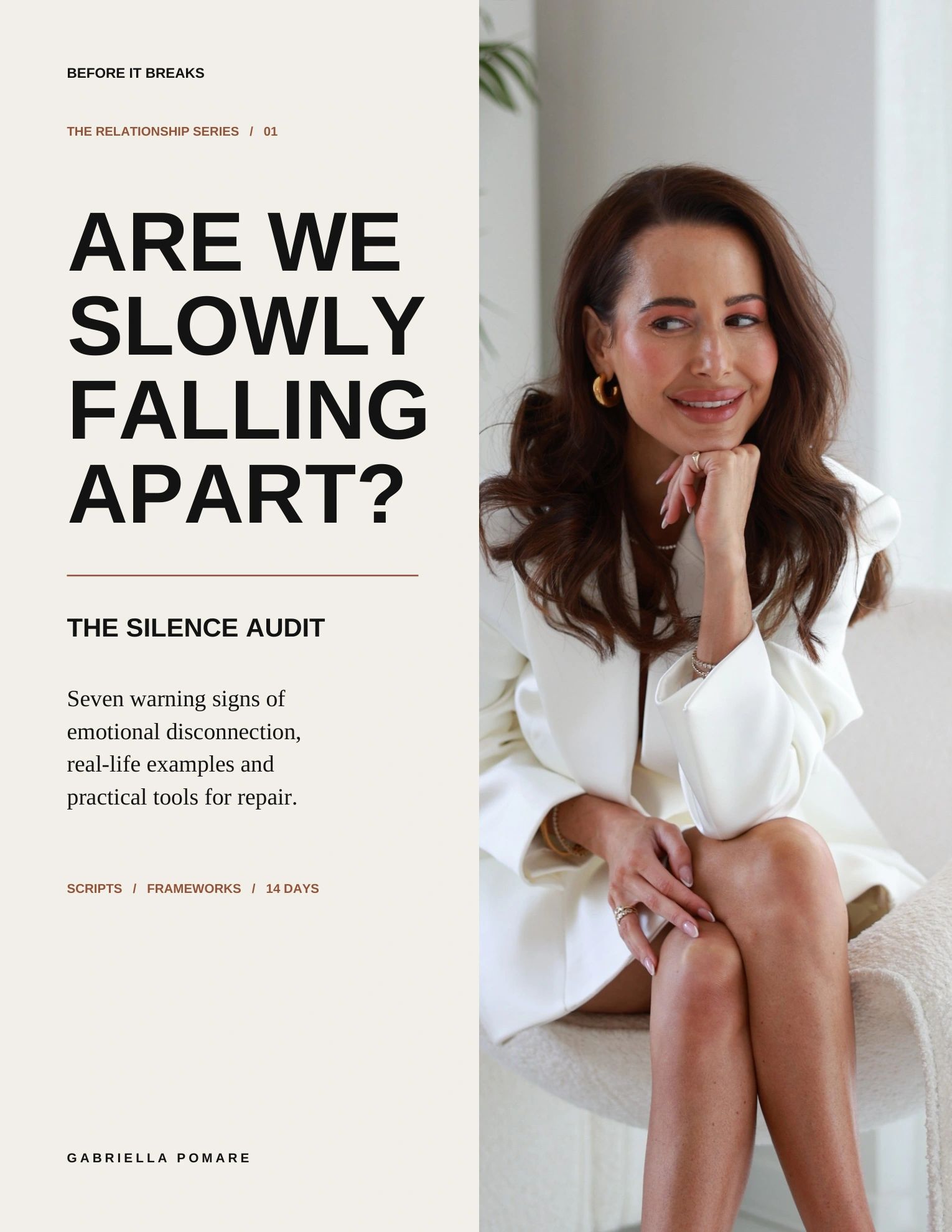
Are We Slowly Falling Apart? | The Silence Audit

Seven warning signs of emotional disconnection, real-life examples and practical tools for repair.


A 52-page digital relationship guide by Gabriella Pomare


$29.99 AUD | Digital e-book (FREE SAMPLE BELOW)

buy now

ARE WE SLOWLY FALLING APART?

STILL TOGETHER. BUT SOMETHING FEELS DIFFERENT?


You still share a home. You still talk about the children, organise dinner, make plans for the weekend and manage the endless responsibilities of everyday life. But somewhere along the way, something has changed. Perhaps you no longer tell your partner about the little things that happen during your day. Perhaps you've stopped raising the things that hurt because you already know how the conversation will end. Maybe you barely argue anymore, but you don't feel particularly close either.


You can't necessarily explain when the distance began. There hasn't been a dramatic betrayal, a defining argument or a moment when either of you decided to stop trying. You've simply become very good at managing a life together while feeling increasingly disconnected within it. And the absence of conflict isn't always the presence of connection.


For more than a decade, I've worked with couples and families at the point of relationship breakdown. One of the things I've come to understand is that relationships rarely end because of one conversation.


More often, the distance develops through hundreds of conversations that didn't go well, needs that were repeatedly dismissed, promises that never translated into change and moments when somebody quietly decided that asking again was simply too exhausting.


But not every period of emotional distance means a relationship is ending.


Sometimes you're exhausted. Sometimes you're navigating a difficult season. Sometimes you're stuck in a recurring pattern neither of you knows how to interrupt.


And sometimes, something more significant has changed. The important thing is understanding the difference. That's why I created Are We Slowly Falling Apart? — The Silence Audit.

buy now

YOU DON'T NEED ANOTHER LIST OF RELATIONSHIP QUESTIONS.

There is no shortage of relationship advice telling us to communicate better, prioritise date nights, be more affectionate or make time for each other.


But what happens when you've already tried?


What happens when you've explained your feelings repeatedly, but nothing changes? When your partner becomes defensive every time you raise an issue? When you've stopped asking for affection, attention or support because the disappointment has become predictable?


And what happens when you aren't even sure whether the problem is your relationship or simply the extraordinary demands of modern life?


This guide goes beyond telling you to communicate.


It helps you understand why emotional disconnection develops, how to recognise the pattern you're experiencing and what meaningful repair actually requires.


With practical frameworks, detailed relationship examples, realistic conversation scripts and a structured 14-day plan, you'll learn how to move beyond vague frustration and begin identifying what needs to change.


Not through another argument.


Through greater understanding, clearer communication and practical action.

THE FRAMEWORKS YOU'LL KEEP COMING BACK TO

This isn't designed to be another e-book you read once and forget.


Inside, you'll find practical tools you can return to whenever an old pattern begins to resurface:


  • The Silence Audit: Identify, Trace, Translate, Test.
  • The Withdrawal Loop: Understand how repeated conflict and disappointment can lead to emotional withdrawal.
  • The Conversation Re-entry Method: A practical structure for approaching difficult subjects.
  • The Repair Evidence Framework: Five indicators for evaluating meaningful change.
  • The Relationship Check-In: Revisit your progress after 30 and 90 days.


Each framework includes practical explanations, examples and ways to apply it to your own circumstances.

WHO IS THIS GUIDE FOR?

For the person who feels lonely in a relationship that looks perfectly fine from the outside.


For the couple who have become excellent at managing their household but struggle to remember the last time they felt genuinely connected.


For the partner who has stopped raising concerns because nothing seems to change.


For the person who loves their partner but doesn't understand why affection, curiosity or intimacy has gradually disappeared.


For anyone navigating a demanding season of parenting, ambition, work or family life who wants to understand whether the distance they're experiencing is temporary or something that deserves greater attention.


And for people who want to approach their relationships with more intention, rather than waiting until disconnection becomes a crisis.


You don't need to be on the verge of separation to benefit from understanding your relationship better.

SAMPLE FOR YOU TO PREVIEW

WHAT'S INSIDE THE GUIDE?


52 pages of practical relationship insight, frameworks and tools you can return to.


01 / THE SEVEN WARNING SIGNS OF EMOTIONAL DISCONNECTION


Learn to recognise the subtle ways relationships begin to drift, from losing everyday curiosity and withdrawing affection to avoiding difficult conversations and becoming more like household managers than romantic partners.


Understand why emotional distance doesn't always mean a lack of love, and why the reasons behind withdrawal matter just as much as the behaviour itself.


02 / REAL RELATIONSHIPS. REALISTIC EXAMPLES.


Explore four recognisable relationship situations involving mental load, ambition, emotional support, intimacy and recurring conflict.


Understand what may be happening beneath the surface, why familiar approaches often fail, and what a more constructive response could look like.


Because sometimes the argument about the dishwasher isn't about the dishwasher at all.


03 / THE SILENCE AUDIT FRAMEWORK


My four-stage method for understanding the conversations you've stopped having.


Identify. Trace. Translate. Test.


Learn how to identify an unresolved issue, examine what happened during previous attempts to address it, understand the deeper need beneath the frustration and turn that understanding into one realistic, observable change.


Includes worked examples and a practical worksheet you can return to whenever an issue begins to feel impossible to discuss.


04 / THE CONVERSATION RE-ENTRY METHOD


Know what you want to say, but struggle with how to say it?


Learn a practical five-step approach to reopening difficult conversations without immediately returning to the same argument.


Observation. Impact. Need. Request. Review.


With nine realistic conversation scripts covering situations such as emotional withdrawal, feeling unsupported, defensiveness, resentment, broken promises and a partner who shuts down.


Importantly, you'll learn not only how to begin the conversation but how to respond when it becomes difficult.


05 / THE REPAIR EVIDENCE FRAMEWORK


An apology can feel reassuring. A promise can create hope.


But neither automatically means something has changed.


Learn how to distinguish acknowledgement from accountability, intentions from action, and temporary improvement from consistent effort.


This framework helps you understand what genuine repair may look like in everyday life and how to evaluate progress without turning your relationship into a constant assessment.


06 / THE 14-DAY RECONNECTION PLAN


A structured, realistic plan to put what you've learned into practice.


Across fourteen days, you'll work through understanding your disconnection, identifying one important issue, preparing a more useful conversation, testing a practical change and reviewing what happens afterwards.


No unrealistic promise to transform your relationship in two weeks.


Just thoughtful, manageable steps designed to help you understand what is possible, what needs attention and what might need a different approach.

Download PDF

Frequently Asked Questions

Emotional disconnection can develop when partners begin to feel less understood, supported, wanted or involved in each other's inner lives. It may appear through reduced intimacy, avoidance of difficult conversations, increasing resentment or a sense that the relationship has become primarily about managing practical responsibilities.


It can have many causes, including stress, exhaustion, unresolved conflict and changing relationship dynamics. Emotional distance doesn't automatically mean the relationship is over.


Quietly quitting a relationship describes the gradual withdrawal of emotional effort or investment without formally ending the relationship.


A person may stop initiating conversations, asking for change or attempting to resolve recurring issues because previous efforts have felt unsuccessful.


However, withdrawal can also reflect burnout, emotional self-protection or other difficulties. Understanding the circumstances behind the behaviour is essential.


Sometimes. Reconnection may be possible when both partners are willing to understand what has changed, communicate openly and participate in meaningful behavioural change.


The guide provides practical tools to help identify the issues, approach difficult conversations and understand what sustained repair may require.


It does not guarantee reconciliation or suggest that one person can repair a relationship alone.


Yes. You can complete the reflection exercises and use the frameworks independently.


The guide also explains which changes are within your control and which require your partner's willingness and participation.


You do not need your partner to read the guide to begin understanding your own experiences.


Yes. The guide explores situations commonly experienced in marriages and long-term relationships, particularly where practical responsibilities, parenting, careers and established routines have begun to affect emotional connection.


It is also relevant to other committed relationships.


Copyright © 2026 Gabriella Pomare | Relationship Expert, Author, Keynote Speaker Australia - All Rights Reserved.

  • HOME
  • SUBMIT DEAR GABRIELLA
  • TV SEGMENTS
  • PODCAST FEATURES
  • PRESS MEDIA
  • CONTACT
  • Privacy Policy
  • Terms and Conditions

Powered by

This website uses cookies.

We use cookies to analyze website traffic and optimize your website experience. By accepting our use of cookies, your data will be aggregated with all other user data.

Accept