Episode 4: When Work Becomes The Third Person
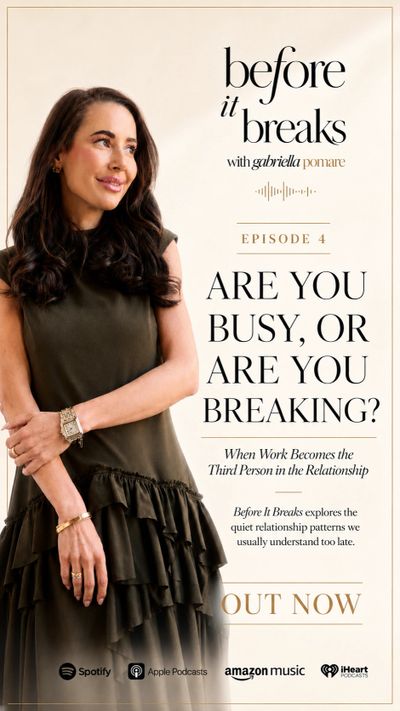
Episode 4: When Work Becomes the Third Person in the Relationship | Before It Breaks Podcast
What happens when work becomes more than work?
In Episode 4 of Before It Breaks with Gabriella Pomare, Gabriella explores one of the most common but least spoken about relationship pressures of modern life: what happens when the job, the inbox, the business, the deadline, the client, the laptop or the phone quietly becomes the third person in the relationship?
This episode looks at the couples who are still together, still functioning, still sharing a life, but where one person feels like they are competing with work for attention, softness, intimacy and emotional presence.
It is about the call taken at dinner. The laptop in bed. The “just one more email.” The busy season that never ends. The holiday where work comes too. The partner who is physically home, but emotionally still somewhere else.
Listen on: Spotify | Apple Podcasts | Amazon Music | iHeartPodcasts
What Episode 4 is about
Episode 4 explores how work can quietly become a relationship’s biggest competitor.
Work is not always the villain. Work can be purpose, identity, provision, survival, ambition, independence and love in action. It can be the thing that pays the mortgage, builds the business, supports the family, creates safety and gives someone a sense of meaning.
But when work starts receiving the best version of someone, and the relationship only receives what is left over, something begins to change.
This episode asks what happens when ambition, overwork, phone distraction, emotional absence and career pressure begin to replace intimacy, connection, rest and presence at home.
It is not about blaming the person who works hard. It is about asking whether the relationship is still being protected inside the pressure, or whether love has become something that is always scheduled for later.
Key themes in this episode
This episode explores:
Work as the third person in the relationship and how a job, business, career or inbox can begin occupying the emotional space between two people.
Emotional absence and what it feels like to be beside someone who is physically present but mentally and emotionally still at work.
Ambition and modern relationships and why ambition can be meaningful, seductive, necessary and complicated.
Relationship burnout and how constant work pressure can create resentment, loneliness and emotional disconnection.
Phone distraction and digital interruption including emails at dinner, laptops in bed, work calls on holidays and the “just one more thing” cycle.
Work-life balance in relationships and why the goal is not always to work less, but to stop letting work become the only thing that is allowed to be urgent.
Loneliness in marriage and long-term relationships when one person feels like the job receives the best energy, and the relationship receives the exhausted remainder.
Modern marriage and career pressure including the emotional cost of building a business, providing for a family, pursuing success or trying to stay constantly available.
Relationship repair and how couples can begin talking about work, absence and emotional availability before resentment becomes the dominant language.
Why work can become the third person
Work rarely enters a relationship looking like the enemy.
It often enters looking responsible, impressive and necessary. It may look like ambition, provision, financial security, purpose, identity, survival, or “I’m doing this for us.”
At first, most couples can understand a busy season. There may be a major project, a launch, a difficult client, a promotion, a business pressure, a financial stress or a period where one person genuinely has to give more to work.
But sometimes the busy season becomes the whole relationship.
The exception becomes the rhythm. The phone at dinner becomes normal. The laptop in bed becomes normal. The interrupted holiday becomes normal. The distracted conversation becomes normal. The relationship begins organising itself around work, rather than around connection.
That is when work stops simply supporting the life, and starts quietly taking over the life.
Cultural context: The Devil Wears Prada, Marriage Story, The Intern and La La Land
In this episode, Gabriella also explores why this theme appears so often in films and popular culture.
In The Devil Wears Prada, Andy is pulled into a world where her work self becomes shinier, more admired, more needed and more exciting, while her relationship begins to feel ordinary, inconvenient and easy to postpone.
In Marriage Story, the pain is not simply about one event, but about ambition, sacrifice, career, identity and the private ledgers couples keep about whose dreams had more oxygen.
In The Intern, Jules represents a more modern version of this dynamic: a brilliant, ambitious woman building a business while also trying to carry marriage, motherhood, leadership, identity and pressure.
In La La Land, two people love each other, but their dreams begin pulling them into different lives. It captures the ache of realising that love may still exist, but the life required to keep that love alive may not.
These stories resonate because they are not really just about work.
They are about what happens when the thing that was supposed to build the life starts quietly taking over the life.
The loneliness of being beside someone who is still at work
One of the central ideas in this episode is that presence is not just location.
Someone can be home and still not be emotionally available. They can sit at the dinner table, lie beside you in bed, attend the family lunch or come on the holiday, but still feel mentally pulled into the inbox, the meeting, the client, the deadline or the pressure of tomorrow.
That kind of loneliness can be difficult to explain because the person is technically there.
But emotional presence is not only about being in the room. It is about attention, softness, curiosity, availability and the feeling that the outside world has been put down long enough for the person in front of you to feel chosen.
Episode 4 explores the grief of feeling like you are competing with something you cannot name, because work always has a reason.
The “busy season” that never ends
Many couples can survive a busy season.
The problem is when the busy season becomes the climate of the relationship.
The phrase “after this month” becomes “after this year.” The one late night becomes a routine. The weekend email becomes expected. The holiday call becomes unavoidable. The relationship keeps waiting for things to calm down, but work keeps creating new reasons to stay urgent.
This episode asks:
When does temporary pressure become a permanent pattern?
When does ambition become avoidance?
When does providing for the relationship begin replacing being present in the relationship?
And when does love begin to feel lonely because it is always scheduled for later?
The phone, laptop and inbox in modern relationships
Modern work has changed relationships because work no longer stays at work.
It follows people into the car, the kitchen, the bedroom, the school assembly, the family lunch, the holiday and the middle of the night.
The phone means people are constantly reachable, but it can also mean they are never fully reachable to the people beside them.
Episode 4 explores how small interruptions can become relationship injuries over time: the call taken during dinner, the email answered in bed, the phone lighting up mid-conversation, the “just one second” that becomes twenty minutes, and the story that is never finished because one person can see they have lost the other’s attention.
These moments may seem small, but repeated interruption can create real emotional distance.
Can ambition and intimacy coexist?
Yes. This episode is not anti-work or anti-ambition.
Ambition can be deeply meaningful. It can build a life, create safety, support a family, model purpose, create independence and allow someone to become more fully themselves.
The question is not whether work matters.
The question is whether work has become unchallenged.
Does work automatically win? Does it receive the best energy, the calmest voice, the quickest replies and the most focused attention, while the relationship receives the exhausted remainder?
Healthy ambition and healthy intimacy can coexist, but the relationship must also be protected. It needs space, attention, repair, ritual and emotional availability. It needs to be allowed to feel urgent too.
Who this episode is for
This episode is for anyone who has ever felt like they are competing with a partner’s career, inbox, business, ambition or constant availability to everyone else.
It is for the person whose partner is technically home, but emotionally still at work.
It is for the person who respects their partner’s ambition, but still feels lonely beside it.
It is for the person who works constantly and feels like no one understands the pressure they are carrying.
It is for the couple trying to build a life, but slowly realising they may not be living inside it together.
It is for anyone who has ever said, “I know work matters, but when do I get you?”
It is also for professionals, leaders, founders, parents, family lawyers, counsellors, coaches and anyone working with modern families who wants to understand how career pressure, overwork and emotional absence can shape relationships before they break.
Gabriella speaks on modern relationships, co-parenting, emotional load, family law, motherhood, communication, leadership and family change.
What is Episode 4 of Before It Breaks with Gabriella Pomare about?
Episode 4, When Work Becomes the Third Person in the Relationship, explores how work, ambition, overwork, phone distraction, career pressure and emotional absence can create distance, resentment and loneliness in modern relationships.
Can work damage a relationship?
Work can damage a relationship when it consistently takes priority over connection, intimacy, emotional presence and repair. Work is not always the problem, but when it receives the best of someone and the relationship only receives what is left over, resentment and emotional disconnection can grow.
What does it mean when work becomes the third person in a relationship?
Work becomes the third person in a relationship when it starts occupying the emotional space between two people. This may look like constant emails, phone calls at dinner, laptops in bed, emotional absence, cancelled time together, and one partner feeling like they are competing with the job, business or inbox.
Why do people become emotionally unavailable because of work?
People may become emotionally unavailable because of work when they are under pressure, burnt out, constantly reachable, financially stressed, highly ambitious or using work as a place to feel competent, admired, needed or in control. Sometimes work becomes easier to manage than intimacy.
How does phone distraction affect relationships?
Phone distraction can affect relationships by interrupting emotional connection, reducing attention, creating resentment and making one partner feel less important than work emails, messages or notifications. Repeated small interruptions can become a pattern of emotional absence.
Can ambition and a healthy relationship coexist?
Yes. Ambition and a healthy relationship can coexist when both people protect the relationship as well as the work. This means creating boundaries, emotional presence, protected time, honest communication and recognition that the relationship must also be treated as important and urgent.
What are signs work is affecting your relationship?
Signs may include constant work interruptions, emotional absence, reduced intimacy, repeated cancelled plans, phone use during shared time, resentment, one partner feeling lonely, the other feeling criticised, and the relationship consistently receiving only what is left after work.
How can couples repair when work has taken over?
Couples may begin repair by having honest conversations about loneliness, pressure and availability, creating protected time without work interruptions, setting boundaries around phones and emails, acknowledging the impact of absence, and seeking professional support where needed.
Is Before It Breaks legal advice?
No. Before It Breaks with Gabriella Pomare is for general information and education only. It is not legal advice or therapeutic advice. If you need advice about your own relationship, separation, divorce, parenting or legal circumstances, speak with an appropriately qualified professional.

Free tools, resources and new podcast episodes
Sign up to receive free co-parenting resources, communication scripts, practical advice, course updates, event announcements and thoughtful guidance to help you navigate separation, co-parenting and modern family life with more calm and clarity.
You will also be the first to know when new episodes of Before It Breaks are released, with reflections, tools and conversations about what happens inside relationships, families and ourselves before things break, and how we can begin to repair, rebuild and respond differently.